Guideline for Installation of Fire Hose Pipe

FIRE HOSE PIPE REFERENCE

Guideline for Installation of Fire Hose Reel

FIRE HOSE REEL REFERENCE

Area Code Clause No Descriptions
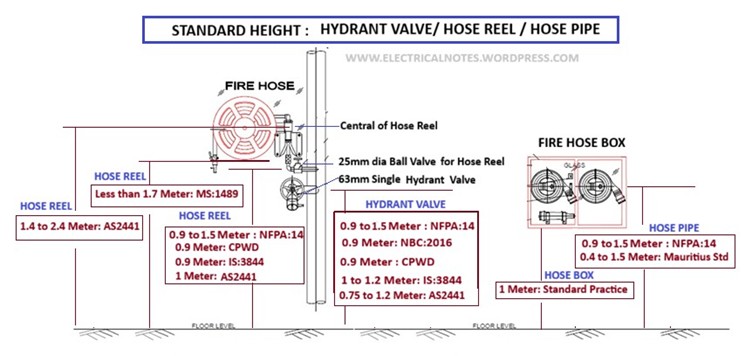
Installation Height AS 2441 11.b The fire hose reel assembly shall be suitably mounted at a spindle height of between 1.4 Meter and 2.4 Meter above floor level. The stop valve shall be mounted at 1 Meter (±100 mm) above floor level. NOTE: The recommended mounting height of the centre of the fire hose reel is 1500 mm above floor level.
NFPA:14 7.3.1.1 Hose connections and hose stations shall be unobstructed and shall be located not less than 3 ft (0.9 m) or more than 5 ft (1.5 m) above the floor.
MS 1489:1-2023 The installation height of hose reels should not exceed 1.7 Meter from floor level.
CPWD 8.3.4 .4 Hose Reel inlet valve shall be at 900 mm above floor level.
IS 3844 6.2  When installation is in open areas, the position should be above head height and the nozzle retainer and the inlet valve should be at about 900 mm above floor level.
Clear Distance AS2441 11.c The stop valve assembly and instructions shall be visible and readily accessible when the fire hose reel is ready for operation, and shall be not more than 2 Meter from the spindle of the hose reel assembly. A clearance of not less than 100 mm shall be provided around the stop valve handwheel or handle at any point where an operator needs to place their hand.
AS1221 11.d When the fire hose reel is surface-mounted or in a recess, cabinet or cavity, there shall be a minimum radial clearance of 100 mm between the reel rim and any obstruction to the sides, above and below that does not form part of the fire hose reel assembly. In the case of swing-type fire hose reels and those housed in cavities; the above clearance applies when the fire hose reel is withdrawn from the cabinet or cavity.
Installation Location NBC:2016 5.1.1(g) Hydrants for firefighting and hose reels shall be located in the lobby in firefighting shaft. Those hydrants planned to be provided near fire exit staircase on the floor shall be within 5 Meter from exit door in exit access
IS 3844 6.1 In addition to wet-riser systems, first aid hose reels should be installed on all floors of buildings above 15 m in height. The hose reel should be directly taken from the wet-riser pipe by means of a 37 mm socket and pipe to which the hose reel is to be attached. When taken from the landing valve, it should be connected to one of the female couplings of the double outlet landing valves of the wet-riser installation by means of an adapter.
IS 3844 6.2 The hose reel should be sited at each floor level, staircase, lobby or mid-landing adjacent to exits in corridors in such a way that the nozzle of the hose can be taken into every room and within 6 Meter of any part of a room keeping m view the layout and obstructions. The doors provided for the hose reel recesses should be capable of opening to approximately 180°.
IS 3844 6.5 The length of hose reels should be such that no part of the floor so protected is more than 6 Meter away from the nozzle when the hose reel is fully extended. 


IS 3844 14.1  For buildings where narrow space does not permit fixing of hose boxes, the fire hoses, and hose reel could be fixed in suitable niches through which the riser main has been taken up. In such cases only a glass facing fixed on a frame of angle iron may be used. However, these may be used only for residential apartments,
Hose Reel Sign AS 2441 10.4.3 Signs Mounting height: Signs shall be mounted not less than 2 Meter above floor level, or at a height that makes them most apparent to a person of average height and visual acuity approaching the fire hose reel location.

Guideline for Installation of Internal & External Hydrant


INTERNAL & EXTERNAL FIRE HYDRANT REFERENCE

Area Code Clause No Descriptions
Installation Height NFPA:14 7.3.1.1 Hose connections and hose stations shall be unobstructed and shall be located not less than 0.9 Meter or more than 1.5 Meter above the floor. This dimension shall be measured from the floor to the centre of the hose valve.
NBC:2016 5.1.1 (a) Hydrant Valve shall be 0.9 Meter from Ground Level
CPWD 8.2.4.1 The landing valve shall be fitted to a T-connection of the riser at the landing in such a way that the valve is in the center of the internal hydrant opening and at a height of 0.9 Meter from floor level.
IS 3844 5.9 Landing valves should be installed on each floor level and on the roof, if accessible, in such a way that control line of landing valve is 1 to 1.2 Meter above the floor level. In the event of pump pressure being excessive at the lower floor levels in tall buildings a reducer should be provided in the landing valves to limit operating pressure to 5.5 kg/cm2 (0.5 N/mm2). The hoses, nozzles and branch pipes should be kept adjacent to the landing valves in wall boxes or in recesses.
CPWD 8.2.4.2 The valve base shall be vertical and the valve facing outside. There should be no hindrance in operation of the handle.
AS2419.1 3.2.2.1 The  centre line of the  fire hydrant valve or outlet not less than  0.75 Meter and  not more than 1.2 Meter above the ground, finished floor level or platform and have the  tire hydrant valve outlet horizontal or sloping not more than 30 deg   below the horizontal.
IS 13039 4.4 External Hydrant: In external Area All hydrant outlets shall be situated 1 Meter above ground level.
Clear Space around Hydrant NFPA:1 18.5.7.1 914 mm clear space shall be maintained around the circumference of fire hydrants except as otherwise required or approved.
NFPA:1 18.5.7.2  A clear space of not less than 1.5 Meter shall be provided in front of each hydrant connection having a diameter greater than 64 mm.
NFPA:14 4.7.5 Hose connections shall be located so that there is at least 76.2 mm clearance between any adjacent object and the handle of the valve when the valve is in any position ranging from fully open to fully closed.
NFPA:14 7.3.1.2 The hose connection shall not be obstructed by the closed or open door or other objects on the landing.
CPWD 3.2.4 Internal hydrant shall be easily accessible. A clear space of at least 1.5 Meter should be available in front of the internal hydrant for operation. Internal hydrant shall not be provided in a lockable room.
AS2419.1 3.2.2.2.a A clearance of not less than 1 Meter directly in front of the  fire hydrant outlet and laying of fire hose.
AS2419.1 3.2.2.2.b A clearance of not less than 500 mm tram any point ot a door-swing arc and the tire hydrant outlet where installed in a fire isolated stair
AS2419.1 3.2.2.2.c A clearance of not less than 100 mm around the handwheel of the fire hydrant valve, in both the fully closed and fully open positions, to allow for the turning on and off of the fire hydrant valve.
AS2419.1 3.2.2.2.d A clearance around the fire hydrant valve outlet of not less than 300 mm through an arc of 225° in the plane of the valve outlet, to facilitate the use of a hose spanner for the connection and disconnection of fire hose.
Location of Internal Hydrant Point NFPA:14 7.3.2 Class I Systems. Class I systems shall be provided with 65 mm hose connections in the following locations:
(1) At the main floor landing in exit stairways
(2) On each side of the wall adjacent to the exit openings of horizontal exits
(3) In other than covered mall buildings, in each exit passageway at the entrance from the building areas into the passageway
(4) In covered mall buildings, at the entrance to each exit passageway or exit corridor, and at the interior side of public entrances from the exterior to the mall
(5) At the highest landing of stairways with stairway access to a roof, or on roofs with a slope of less than 4 in 12 where stairways do not access the roof
NBC:2016 5.1.1(g) Hydrants for firefighting and hose reels shall be located in the lobby in firefighting shaft. Those hydrants planned to be provided near fire exit staircase on the floor shall be within 5 Meter from exit door in exit access
IS 13039 4.19.7 A hydrant shall be provided on every floor landing which shall be not less than 1.25 Meter area
CPWD 3.2.4 Internal Hydrant: Internal hydrants are provided to fight fire from within the building. Following factors are considered for deciding location of internal hydrant:
(i) Internal hydrants are provided at every floor at the same location and connected with risers.
(ii) Hydrant for firefighting shall be located in the lobby in firefighting shaft. Those hydrants planned to be provided near fire exit staircase on the floor shall be within 5 Meter from exit door in exit access.
(iii) Numbers and location of risers shall be decided as per Para 2.4.1.6. Every wing of the building shall preferably be provided with independent hydrants. Hydrant shall be located in the center of the building so that one hydrant can cover area on both sides.
NFPA:14 7.3.2.2.1.1 The travel distance for Fire Hose shall be 61 Meter for sprinklered buildings.
NFPA:14 7.3.2.2.1.2 The travel distance for Fire Hose shall be 39.7 Meter for non sprinklered buildings.
NFPA:14 7.3.2.2.1.3 Fire Hydrant connections shall be provided in each exit passageway in other than covered mall buildings.
NFPA:14 7.3.2.5 A single hose connection shall be permitted to be installed in the open corridor between open stairs that are not greater than 23 Meter apart.
NFPA:14 7.3.2.10 Additional hose connections shall be provided in Non sprinklered buildings where the distance from connections required to the most remote portion or story exceeds 45.7 Meter
NFPA:14 7.3.2.11 Additional hose connections shall be provided in buildings sprinklered where the distance from connections required to the most remote portion or story exceeds 61 Meter
NFPA:14 7.3.2.1 Hose connections shall be permitted to be located at the highest intermediate landings between floor levels in exit stairways where required by the AHJ.
IS 13039 4.16 High Hazard Area: In case of buildings/plants occupied for high hazard process or storage areas, the hydrants shall be located at a minimum distance of 15 Meter from the periphery of storage tank or hazardous equipment under protection.
IS 13039 4.17 If any point within the building is at a distance of more than 45 Meter from an external fire hydrant, an internal hydrant system shall be provided so that no portion of the floor is more than 45 Meter from an external hydrant or 30 Meter from an internal hydrant. Distance of 45 Meter indicated above shall be increased to 60 Meter for light hazard occupancies and reduced to 30 m for high hazard occupancies.
IS 3844: 5.12 For single headed landing valve, the front opening glass door may be of single leaf, but for double landing valve, double leaf doors are recommended. The location of the riser main, along the landing valves and hose reel, etc, should be such as to leave enough clearance on both sides and also below the landing valve, for smooth operations. The landing valves should be so fitted to the riser main, that when the fire hose is connected to it, and charged with water under pressure, it will not form any kin& Consideration should alsp be given to allow adequate. spaces, around the valve to permit maintenance and testing
Location of External Hydrant Point NFPA:1 18.5.1.6 Fire hydrants shall be located not more than 3.7 Meter from the fire department access road.
IS 13039 4.12 In External Area: At least one hydrant post shall be provided for every 60 Meter of external wall measurement in case of light hazard occupancy, for every 45 Meter in case of ordinary hazard occupancy and every 30 Meter of external wall measurement or perimeter of building/unit battery limit in case of high hazard occupancy.
IS 13039 4.13 In External Area: Where any part of a building is normally used  for storage purpose or where hazardous processes are carried out, there shall be two single or one double headed hydrant within 15 Meter of the building, the layout being such that two jets of water can be played simultaneously on the highest point of the roof.
IS 13039 4.15 In External Area:  For light and moderate hazard risks, hydrant heads shall be positioned at distances not less than 2 Meter from the face of the building or edge of the storage plot to be protected. Such buildings shall not be deemed to be protected by a hydrant unless such hydrant is within 15 Meter of the building.
IS 13039 4.16 High Hazard Building: In the case of Whole Building is high Hazard the distance of Fire Hydrant shall be not less than 5 Meter and more than 15 Meter from the face of building. Hydrants/Monitors shall be located along road side for easy accessibility as far as possible.
CPWD 2.4.1.8.1 External Hydrant: For fighting fire from outside the building, yard hydrants are provided around the building and in the closed court yard. For connecting yard hydrants, a ring of pipe shall be laid underground around the building at a minimum distance of 2 Meter from the face of the building. All internal risers shall be connected with this ring.
CPWD 2.4.1.8.1 External Hydrant: Yard hydrants shall be located at a minimum distance of 2 m but not more than 15 m from the building face. The yard hydrants shall be easily accessible and should normally be provided near boundary wall/along road. While locating yard hydrants it should be ensured that same do not become hindrance in vehicular movement or entrance to the building. Yard hydrants, should be located around the building in such a way that it should be possible to fight fire on any face of the building from the nearest hydrant. At least one hydrant post shall be provided for every 45 Meter
AS2419.1 3.5.3.1 Not less than 10 Meter from the building or fire compartment it is protecting.
AS2419.1 3.5.3.1 Not less than 10 Meter from any high voltage main electrical distribution equipment such as transformers and distribution boards.
AS2419.1 3.5.3.1 Not less than 10 Meter from any Electric Vehicle Charging Station regardless of voltage unless protected by a wall or other construction having an FRL.
AS2419.1 3.5.3.1 Not less than 10 Meter   from   a   stored   quantity   of   dangerous   goods   (e.g.   LPG, petroleum, propane).
AS2419.1 3.5.3.1 Not less than 10 Meter from external combustible storage (e.g. palletized combustible storage items).
AS2419.1 3.5.3.1 Not less than 3 Meter from the vent   terminal   of   any   gas   assembly   or   gas measurement system.
Fire Department Connection NFPA:14 6.4.6  Fire department connections shall be located not less than 0.45 Meter nor more than 1.2 Meter above the level of the adjoining ground, sidewalk, or grade surface.
NFPA:24 5.9.5.1 Fire department connections shall be located on the street side of buildings.
IS 3844 3.2 Fire Service Connections (Tank Filling): This is a 4 Way collecting breeching with blank caps (without non-return valve) fixed to a 150-mm dia pipe which is connected to the fire tank for filling from external source.
IS 3844 5.11 A minimum of two hydrants connected to internal hydrant system should be provided within the courtyard of the buildings. These should preferably be sited adjacent to the roads along the compound wall and facilities provided for fire brigade appliances.
Fire Inlet Connection IS 3844 3.19 Fire Service Inlet: 2 Way or 3 Way collecting head (see 5.1.1 and 5.2.3) with non-return valves fitted to the down-comer/wet-riser main, so that in case of need, fire service can directly pressurize the system with their pump.
IS 3844 5.2.3 Fire Service Inlet (Raising Main) : Fire service inlet with gate and non-return valve to charge the riser in the event of failure of the static pump directly from the mobile pump of the fire services should be provided on the wet-riser system. The fire service inlet for 100 mm internal diameter rising main should have collecting head with 2 numbers of 63 mm inlets and for 150 mm rising main, collecting head with 4 numbers of 63 mm inlets should be provided.
IS 3844 5.5.1.a Fire Service Inlet (Raising Main of Each Zone): A fire service inlet at ground level fitted with a non-return valve should also be provided to the rising main of each zone for charging it by fire service pumps, in case of failure of fire pump. If two rising mains are within a distance of 30 m horizontally a single fire service inlet will be sufficient.
IS 3844 5.5.1.b The fire service Inlet should be located and arranged on street side of the building preferably near main entrance, prominently marked and without any obstruction so that fire service can connect hose lines without difficulty.
IS 3844 5.5.1.c The inlet should be located inside a box made of 1.6 mm mild steel plate with openable 4mm thick glass frontage with locking arrangements. The words ‘Fire Service Inlet’ should be written in letters at least 75 mm in height and 12 mm in width in fluorescent fire red colour (IS 5: 1978).


Guideline for Installation of Fire Extinguisher

Guideline for Installation of Fire Extinguisher

FIRE EXTINGUISHER REFERENCE
AreaCodeClause NoDescriptions
Mounting HeightNFPA 106.1.3.8.1Fire extinguishers having a gross weight not exceeding 18.14 kg shall be installed so that the top of the fire extinguisher is not more than 1.53 Meter above the floor.
NFPA 106.1.3.8.2Fire extinguishers having a gross weight greater than 18.14 kg (except wheeled types) shall be installed so that the top of the fire extinguisher is not more than 1.07 Meter  above the floor.
NFPA 106.1.3.8.3In no case shall the clearance between the bottom of the hand portable fire extinguisher and the floor be less than 102 mm.
OSHA 1910.157(c)(1)To prevent fire extinguishers from being moved or damaged, recommends mounting on brackets or in wall cabinets, with carrying handles 0.9 to 1.5 Meter  above the floor.
OSHA 1910.157(c)(1)Larger extinguishers should have the carrying handle about 0.9 Meter from the floor. This also aligns with general fire extinguisher mounting requirements.
AS2445 No extinguisher should be mounted higher than 1.2 Meter off the floor. The bottom of the extinguisher should be no less than 100mm from the floor.
NBC: 20165.1.1These fire extinguishing equipment and their installation  shall  be  in  accordance with accepted standards [4(17)]. The extinguishers shall be mounted at a convenient height to enable its quick access and efficient use by all  in  the  event  of  a  fire  incidence.
PlacementNFPA 106.1.3.1Fire extinguishers shall be conspicuously located where they are readily accessible and immediately available in the event of fire.
NFPA 106.1.3.2 Fire extinguishers shall be located along normal paths of travel, including exits from areas.
IS 2190 : 20106.2Generally, fire extinguishers should be placed as near as possible to exits or stair lands without hindering the escape routes. Wherever possible, advantage should be taken of normal routes of escape by placing these in positions where these shall readily be seen by persons following the natural impulse to get out of danger.
IS 2190 : 20106.3The extinguishers should be available for immediate use at all times. Extinguishers should be
sited in such a way that the user may not have to travel more than 15 Meter  from the site of the fire to reach the extinguishers. Similar positions on each floor are advisable.
AS2444Section 2.3.10Fire extinguishers should be located between 2 Meter and 20 Meter the hazard (eg: switchboard, kitchen..)
NFPA 10E.3Class A: Where the floor area of a building is less than 279 m2 at least one fire extinguisher of the minimum size recommended should be provided.
Maximum travel distanceNFPA 106.2.1.2.2Class A Hazards: Fire extinguishers shall be located so that the maximum travel distances shall not exceed 22.9 Meter, except as modified by 6.2.1.4.(Where hose stations are so provided, they shall conform to NFPA 14.)
NFPA 106.3.1.3Class B Hazards: Fire extinguishers shall be located so that the maximum travel distances do not exceed 9 Meter to 15 Meter.
NFPA 106.3.3.1Class B Hazards: Where hand portable fire extinguishers are installed or positioned for obstacle, gravity/three-dimensional, or pressure fire hazards, the actual travel distance to hazard shall not exceed 9.1 Meter unless otherwise specified.
NFPA 106.3.3.2Class B Hazards: Where wheeled fire extinguishers of 56.7 kg agent capacity or larger are installed or positioned for obstacle, gravity/three-dimensional, or pressure fire hazards, the actual travel distance to hazard shall not exceed 30.5 Meter unless otherwise specified.
NFPA 106.5.2Class D Hazards: Fire extinguishers or extinguishing agents (media) shall be located not more than 22.9 Meter of travel distance from the Class D hazard.
NFPA 106.6.2Class K Hazards: Maximum travel distance shall not exceed 9.1Meter from the hazard to the extinguishers.
OSHA1910157(d)(2)Class A: Portable fire extinguishers must be placed so that the travel distance for employees to any extinguisher is 22.8 Meter feet or less
OSHA1910157(d)(4)Class B: Portable fire extinguishers must be placed so that the travel distance for employees to any extinguisher is 15 Meter or less
OSHA1910157(d)(5)Class D: Portable fire extinguishers must be placed so that the travel distance for employees to any extinguisher is 22.8 Meter or less
OSHA1910157(d)(6)Class K: Portable fire extinguishers must be placed so that the travel distance for employees to any extinguisher is  9 Meter or less
IS 2190 : 20105.4.1Class-A: Fire extinguishers shall be located so that the maximum travel distances shall not exceed 15 Meter for all type of Hazard
IS 2190 : 20105.4.2Class-B: Fire extinguishers shall be located so that the maximum travel distances shall not exceed  9 Meter for Light Hazard  and 15 Meter for all rest of Hazard
IS 2190 : 20105.4.3Class-C: Fire extinguishers with Class C ratings shall be required where energized electrical equipment can be encountered. This requirement includes situations where fire either directly involves or surrounds electrical equipment. Since the fire itself is a Class A
or Class B hazard, the fire extinguishers shall be sized and located on the basis of the anticipated Class A or Class B hazard
IS 2190 : 20105.4.4Class -D: Fire extinguishers or extinguishing agents (media) shall be located not more than 15 Meter of travel distance from the Class D hazard
Fire Extinguisher Sign HeightNFPA 106.1.3.3.3Signs or other means used to indicate fire extinguisher location shall be located in close proximity to the extinguisher
NFPA 10B.1.3 Where markings are applied to wall panels, and so forth, in the vicinity of fire extinguishers, they should permit easy legibility at a distance of 4.6 Meter.
OSHA1910.157OSHA regulations only require that portable fire extinguishers be identified
AS2444 The sign must be mounted such that it is no less than 2 Metres from the floor level or at a height that makes it the most apparent to a person of average height and visual acuity’
AS2444 The extinguisher or extinguisher sign shall be clearly visible for up to 20 Metres on approach. The size of the sign shall be determined by location on and distance at which the sign must be legible
Fire Extinguisher PlanIS 2190 : 20106.9A framed plan showing the location of fire extinguishers, means of access and other useful
information should be displayed at suitable places on each floor, but should be available near to the entrance to the premises preferably at the security gate or the reception office

Guideline for Manual Call Point

MANUAL CALL POINT REFERENCE
Area Code Clause No Descriptions
Mounting Height NFPA 72 17.14.5  The operable part must be between 1.07 meter to 1.22 meter above the finished floor.
BS 5839-1:2025 20.2 Typically mounted at 1.4 meters (0.2m above or 0.3m below) allowing placement between 1.1 meter and 1.6 meter. For disabled access, heights may be lowered to 0.9 meter  to  1.2 meter.
IS 2189  6.3.8 Call points shall be fixed at a height of 1.4 meter above the surrounding floor level, at easily accessible, we illuminated and conspicuous positions, which are free of obstructions.
From Door Distance NFPA 72 17.15.9.6  pull stations are required to be located within 1.5 meters of each exit doorway on every floor, ensuring they are easily reachable during emergencies. 
NFPA 101  9.6.2.3  the manual fire alarm box shall be located within 1525 mm of exit doorways.
NFPA 101  9.6.2.4 Manual fire alarm boxes shall be mounted on both sides of grouped openings over 40 ft (12.2 meter) in width, and within 1525 mm of each side of the opening.
Travel Distance NFPA 101 9.6.2.5 No horizontal distance on that floor exceeding 200 ft (61 meter) shall need to be traversed to reach a manual fire alarm box.
BS 5839-1:2025  20.2 MCPs must be on escape routes and Distribution of MCPs should be such that no one need travel more than 45 meter in certain route (or 30 meter if layouts are uncertain). For disabled residents this should be adapted to within 25 meter to 16 Meter  of each other. For high-risk areas (e.g. kitchens or cellulose paint spraying) a MCP should be sited in close proximity.
NFPA 72 17.15.9.5 Additional manual fire alarm boxes shall be provided so that the travel distance to the nearest manual fire alarm box will not exceed 200 ft (61 meter), measured horizontally on the same floor.
IS 2189  6.3.8 Manual call points shall be so located that, to give an alarm, no person in the premises has to travel distance of more than 30 meter to reach them. When manual call points are also installed external to the building, the travel distance shall be 45 meter
IS 2189  6.3.8 Where necessary, the travel distance may require to be reduced to less than 30 meter, for example, where there is difficulty in free access within the risk or in potentially dangerous risks.
       
Location BS 5839-1:2025    Not placing MCPs at non-final exits or in unsupervised areas like shopping centers.
IS 2189  6.3.8 Manual call point shall be located preferably near entry to staircases at various levels.
NBC 2016  J-9.1.4 Manual call station(s) shall be provided at central location(s) on each platform (near emergency plunger) and at least two on the concourse,  on  each  sidewall. When  the concourse is in two halves, at least one manual call station shall be provided on each side.
BS 5839-1:2017  20.2 MCPs should be located on escape routes and, in particular, at all story exits and all exits to open air that lead to an ultimate place of safety (whether or not the exits are specifically designated as fire exits)
Staircase Landing  BS 5839-1:2017  20.2 MCPs should not be located on stairway landings, as persons travelling down the stairway might operate an MCP several floors below that on which a fire is located, resulting in evacuation of inappropriate areas.
Protecting Cover / Duct Proof BS 5839-1:2025    MCP may provide fitting covers or guards to prevent false alarms and damage.
 NFPA 72 17.14.7 Listed protective covers shall be permitted to be installed over single- or double-action manually actuated alarm initiating devices.
IS 2189  6.3.8 Manual call points shall be housed in dust pre of and moisture proof enclosure properly sealed with rubber lining. 
Recess Mounting IS 2189  6.3.8 Where the call points are not visible from the front as in the case of a long corridor, they shall be surface mounted or semi-recessed in order to present a side profile area of not less than 750 mm.
BS 5839-1:2017  20.2 MCPs may be flush-mounted in locations where they will be seen readily, but, where they will be viewed from the side (e.g. corridors), they should be surface mounted or only semi-recessed with the front face proud of the mounting surface by no less than 15 mm.
MCP Glass Size & Thickness IS 2189  6.3.8 The glass surface shall be minimum 30 mm in area and glass thickness shall not exceed 2 mm. 
MCP/ Pull Station  NFPA 72 17.14.6  Manually actuated alarm-initiating devices shall be permitted to be single action or double action.
NBC 2016  6.4.2.2  The manual call points shall be break glass and not pull stations.
Color  NFPA 72 17.14.8.3 Unless installed in an environment that precludes the use of red paint or red plastic, manual fire alarm boxes shall be Red in color.

Which Class of Wire need to be used for House Wiring

Different Class of Conductor

  • As per IEC 60228, Electrical wires/cables are classified into different classes according to the conductor’s flexibility, conductor hardness & thermal effects.
  • There are four classes of flexibility for electrical cables
  • Class 1 = Solid conductor= ideal conductors for permanent installations.
  • Class 2 =Stranded conductor= conductors designed for fixed installation.
  • Class 5 =Flexible conductor= preferred to used where flexibility is required, for movable equipment , where there is vibration in equipment.
  • Class 6 =Very Flexible conductor= highly flexible conductors used in robotics, flexible codes.
  • Classes 3 and 4 are not described in IEC 60228.
  • The most basic type of conductor is a single, solid wire (Class 1). It provides a smaller diameter, the largest Cross-Sectional Area (CSA), and the clearest signal, it is mechanically fragile and susceptible to breakage after repeated bending cycles.
  • To improve flexibility, wires are stranded together (Class-2, Class-5, Class-6). Class 2 is a multi-wired conductor, while classes 5 and 6 are fine or ultra-fine wired conductors. The IEC standard specifies values such as the maximum diameter and maximum resistance for the individual wires.
  • The more wires that are stranded together to make a given size, the more flexible the conductor will be. This indicates that a higher class corresponds to a greater number of strands within the conductor. Additionally, stranded wires are significantly easier to manipulate and bend during installation compared to a single wire of equivalent cross-section.
  • Classes 1 and 2 are intended for use in cables for fixed installations. On the other hand, Classes 5 and 6 are designed for use in flexible cables and cords but may also be used for fixed installations.

(A) Class 1: Solid Conductors

  • Construction: Single Conductor, solid copper wire.
  • Flexibility: Rigid and non-flexible. the cable should not be bent more than about four times its diameter
  • Characteristics: High electrical conductivity and resistance to corrosion, but less suitable for environments requiring flexibility.
  • Advantages: Less expensive than cables with multiple wires
  • Disadvantages: Less suitable for applications involving movement.
  • Heat and Losses: Class 1 wires are more efficient for fixed wiring due to lower resistance and heat generation. 
  • Applications: Typically used in permanent, stationary installations, House wiring where the conductor will not be subject to frequent movement or low flexibility is not a problem such as in building wiring and power distribution.
  • They are often used when cables with larger cross-sections are required for fixed installations. They are not suitable for very flexible cables, which are used, for example, in continuously moving objects such as robotic arms in industrial production

(B) Class 2: Stranded Conductors

  • Construction: Composed of multiple smaller copper wires twisted or braided together to form a single conductor.
  • Flexibility: More flexible than Class 1, allowing for some movement without breaking or damaging the wire.
  • Characteristics: Offers a balance of flexibility and durability but may not be as conductive as a solid conductor of the same gauge.
  • Advantages:Lower electrical resistance and less heat buildup under load.
  • Disadvantages:Less suitable for applications involving movement.
  • Heat and Losses:Class 2 wires are more efficient for fixed wiring due to lower resistance and heat generation. 
  • Applications: Primarily used for fixed installations like permanent building and house wiring and for industrial applications with increased cable flexibility requirements.

(C) Class 5: Flexible Conductors

  • Construction: Consists of many fine copper wires (often tinned for corrosion resistance) twisted together, making the conductor highly flexible.
  • Flexibility: Extremely flexible, designed for applications where the conductor needs to withstand frequent movement, bending, or vibration without damage.
  • Characteristics: High flexibility, durable against wear and tear, but may have slightly lower conductivity compared to solid conductors due to the finer strands.
  • Advantages:Superior flexibility.
  • Disadvantages:Higher electrical resistance, which can result in greater heat loss and voltage drops.
  • Heat and Losses:Class 5 wires are not efficient for fixed wiring due to higher resistance and heat generation compared to Class-2. 
  • Applications: Used in situations where more flexibility is required, such as in circuits that may need to be bent, coiled, or moved occasionally. Ideal for portable appliances and equipment that move constantly like portable cords, flexible cables, and power tools that require a durable, yet highly flexible conductor.

(D) Class 6: Extra Flexible Conductors

  • Construction: Made up of very fine copper wires, typically tinned, twisted into a very flexible configuration.
  • Compared to class 5, the number of strands and wires arranged around each other is even larger, which can further increase the flexibility of the wire
  • Flexibility: The highest level of flexibility among copper conductors, suitable for applications requiring frequent movement or twisting.
  • Characteristics: Very high flexibility, ideal for dynamic applications, but may have lower conductivity due to the fine strands.
  • Applications: Used in highly flexible cable assemblies, robotics, automobile, machine and tool construction and flexible power cables where the conductor will experience constant movement and mechanical stress.

Which Class of Conductor Used for House hold Wiring:

  • To reduce power consumption, eliminate heating of wires, The Selection of House wire is most important.
  • The selection of Wires broadly depends on conductor Resistance, Current, Quality of conductor material, Cross section area and power consumption.
  • Resistance: A conductor with higher resistance will consume more power (P = I²R, where P is power, I is current, and R is resistance).
  • Current: If both conductors are used in the same application with the same current, the one with the higher resistance will consume more power.
  • Conductor Quality: Many people believe that wire quality simply by measuring its diameter and doing a mathematical calculation to estimate resistance. Conductor resistance is not just about the size of copper but it also depends on copper purity. For example, impure or recycled copper may have a bigger cross-sectional area but still higher resistance, which means more heat, more energy loss and shorter wire life.
  • Conductor Size: The material (copper, aluminum, etc.) and the cross-sectional area of the conductor also significantly affect resistance and power consumption.
  • Power Consumption: The power consumption of a conductor is primarily determined by its resistance and the current flowing through it, rather than its classification (Class 2 or Class 5). However, the classification itself does provide some context regarding the conductor’s characteristics:
  • There are mainly two types of Conductors solid (Class-1) and stranded (Class-2 & Class-5).

(A) Selection between Class-1 or Class-2 (Solid or Standard):

  • Solid conductor (Class-1) has less flexibility hence not easily passing in conceal conduits of house wires and making hot spots at conductor bends. Due to less flexibility easily break conductor at its termination location.
  • The cables used in Building wiring switched to Class 2 copper conductors as it offered better flexibility over the Class 1 solid copper conductors. It is also technically superior and avoid hot spots at bends without compromising the current carrying capacity on account of its resistance being the same as specified for Class 1 copper conductors.
  • Multi-stranded conductor (Class-2) shall be replaced to single solid conductors (Class-1) for all the House wiring.

(B) Selection between Class-2 & Class-5 (Standard or fine Standard):

  • Stranded conductor can be divided broadly in two types one is multi-strand conductor (known as class-2 conductor) other is Flexible stranded conductor (known as class-5 conductor).
  • The difference between Class-2 & Class-5 Wires are as under
  • Resistance: The conductor resistance of class 5 is high compared to class 2 conductor, the heat generated for the same current loading will be different on both class of conductors

Copper Conductor Resistance based on class (IS:694)

Wire Size

Copper Conductor Resistance (Ω/Km)

Insulation Thickness (mm)

Tensile Strength (N/mm2)

CLASS-2

CLASS-5

CLASS-2

CLASS-5

CLASS-2

CLASS-5

0.75 Sq.mm

24.5

26

0.7

0.6

12.5

10

1 Sq.mm

18.1

19.5

0.7

0.6

12.5

10

1.5 Sq.mm

12.1

13.3

0.7

0.6

12.5

10

2.5 Sq.mm

7.41

7.98

0.8

0.7

12.5

10

4 Sq.mm

4.61

4.95

0.8

0.8

12.5

10

  • Insulation: The insulation thickness for the class 5 conductor cable is lesser than specified for class 2, not better for higher load conditions
  • Mechanical Strength: The mechanical strength of insulation for class 5 is lesser in comparison to class 2, this can lead to issues during conduit pull.
  • Flexibility: The difference lies mainly in flexibility.
  • Class 2 wires have fewer strands (Conductor) of more diameter. Example :14/0.31mm(max.) 14 strands each of 0.31 mm (max.). typically, 7 strands are used which makes them less flexible and more suitable for fixed installations.
  • Class 5 wires have more strands (Conductor) of less diameter. Example: 32/0.21mm(max.) 32 strands each of 0.21 mm (max.). Typically, 30 to 50 strands are used, which makes them more flexible and easier to bend.
  • Application: For fixed wiring application conductors with Class 2 copper shall be used. Worldwide the usage of class 2 conductors is specified for building wires as it offers lower resistance, mechanical strength is higher.
  • Class 5 wires are commonly used in applications where flexibility is important, such as in portable appliances and equipment where the lengths are preferably 1.5 to 2-meter, power tools, panel wiring (As bending and routing of such cables in constricted paths do not stress on the cable and handling and installation of such conductors in confined areas is easier).
  • Amount of Copper content: Actually, in class 5 conductors, copper content is less than that of class 2 conductor which make them more flexible wires. The reason is copper wires with class 5 conductor are cheaper.
  • Lesser copper content in wire leads to increased cable resistance and which may in turn increase power consumption and loss. on the other side these coper wires with class 5 conductor can bring disaster in a building as it increases the disconnection time of protective device due to its increased resistance. The power loss of class 5 conductor is higher and is against the concepts of energy conservation or sustainability.
Comparison of Class 2 and Class 5 copper conductors
Property Characteristic CLASS-2 CLASS-5
Installation Passing through Conduit Easy to Pass through Conduits due to less flexible compared to Class-5 Conductor is more Flexible hence change of Cable getting Stuck in Conduit
Termination No of Strands are less hence easy to crip Lugs No of Strands are higher hence difficult to hold all strand under Lugs while crimping
Maintenance In case of replacement easy to pull out Wire from Conduit difficult to pullout from conduit after installation.
Mechanical Tensile Strength Higher mechanical Strength to withstand Stress Mechanically weak compared to Class-2
Loose Connection Cable stay firm near its termination in case of vibration Might get loose in case of vibration
Conductor Roundness Conductor bunch is circular due to less number of strands Due to more no of Strands and it’s arrangement. Not circular as compared to class-2 
Conductor Structure Fewer Strands (Conductor) of large Size More Strands (Conductor) of Small Size
Electrical Resistance Less conductor Resistance Higher Conductor Resistance
Current Capacity Higher Current carrying capacity Less Current carrying capacity
Derating Factor Better conductor roundness makes symmetrical arrangement in conduit, reduce derating Factor Higher derating Factor
Amount of Copper Use of Copper is higher than Class-5 for the Same Size of Conductor Use of Copper is less than Class-2 for the Same Size of Conductor
Power Loss Less Power Loss due to less resistance 6 to 8% Higher Power Loss compared to Class-2
Insulation Insulation thickness is higher than Class-5 Insulation thickness is less than Class-2
Heat Built up Minimal (Due to less Resistance) Heat Faster under Load
Cost Cheaper 5 to 8% Costly (due to more Copper) than Class-5 Cheaper than Class-2
Application Fixed /Movable  Typically used fixed / Permeant Wires installation in wall and ceiling where wires are permeant and used regularly  Used for Flexible application like Power cord, extension Wires Board, for Movable parts
  • Multi-stranded conductor (Class-2) shall be used for house wiring due to its Less Resistance, Less heat loss, Low Power consumption, better insulation, higher mechanical Strength.

Conclusion:

  • Actually, Wires with Class-5 copper are used for appliance wiring and panel wiring (Not Fixed Wiring) only and they are also manufactured accordingly. Wiring with Class-5 copper conductors do not conform to the code of practice of wiring and hence it’s illegal to use them in fixed wiring and In IS 694 specifies panel wire and building wire as a similar group of functioning. This created a confusion and an create opportunity to misuse of Class 5 conductors as building wires because Class-5 Wires are 8 % cheaper than wires with Class-2 copper conductor.
  • However, we must avoid to use Class-5 Wires for Wiring Application due to its less copper content (due to its more flexibility) in wire will lead to increase cable resistance and which may in turn increase the power consumption, higher watt loss, higher voltage drops, higher fault loop impedance.
  • Higher impedance of the circuit may lead to accidents due to higher disconnection time of protective device. Less mechanical strength, less insulation hence heats up in load and not safe in continuous load.
  • For fixed wiring application, House Wiring conductors with Class 2 copper shall be used.

Fire Door / Fire Wall / Fire Sealant / Fire Rated Equipment’s Guideline

Fire Door / Fire Wall / Fire Sealant / Fire Rated Equipment’s

Code Clause No Area Descriptions
NBC-2016 2.24 Fire Tower Wall / Fire Tower Door Fire Tower An enclosed shaft having protected area of 120 min Fire resistance rating comprising protected lobby, staircase and Fireman lift, connected directly to exit discharge or through exit passageway with 120 min Fire resistant wall at the level of exit discharge to exit discharge. The Fire fighting shaft shall be equipped with 120 min Fire doors.
NBC-2016 5.1.1(g) Fire Fighting Shaft (Fire Hose Cabinet) Door Hydrants for firefighting and hose reels shall be located in the lobby in firefighting shaft. Those hydrants planned to be provided near fire exit staircase on the floor shall be within 5 m from exit door in exit access. Such hydrant cabinet may finish with doors to meet interior finishes with requirement of glass panel to provide visibility to the installations inside and inscribed with the word: FIRE HOSE CABINET of letter size 75 mm in height and 12 mm in width. Such door of the fire hose cabinet need not be fire resistant rated. The location of such cabinets shall be shown on floor plan and duly displayed in the landing of the respective fire exit staircase.
NBC-2016 3.4.5.4 Electrical Shaft Door The inspection door for electrical shafts/ducts shall be not less than 120 min Fire resistance.
Model Building-Bye-laws-2016 7.14.d Electrical Shaft Door The inspection panel doors and any other opening in the shaft shall be provided with airtight Fire doors having Fire resistance of not less then 1 hour.
Gujarat Fire Prevention and Life Safety Regulations, 2023 15.2 Electrical Shafts Door Electrical Shafts shall have not less than 2 hours Fire resistance
Model Building-Bye-laws-2016 7.13.a Service Shafts Door Service duct shall be enclosed by walls and door, if any, of 2 hours Fire rating. If ducts are larger than 10 sq m. the floor should seal them, but provide suitable opening for the pipes to pass through, with the gaps sealed.
Gujarat Fire Prevention and Life Safety Regulations, 2023 15.2 Service Shafts Door Services Shafts other than Electrical Shaft, the Fire resistance shall be not less than 1 hour.
NBC-2016 3.4.5.4 Plumbing Shaft Door (Inside the Building) For plumbing shafts in the core of the building, with shaft door opening inside the building, the shafts shall have inspection doors having Fire resistance rating not less than 30 min
NBC-2016 3.4.5.4 Plumbing Shaft Door (Outside the Building) For plumbing shafts doors which open in wet areas or in naturally ventilated areas or on external wall of the building, the shafts may not require doors having any specified Fire rating.
NBC-2016 3.4.5.4 Service Shafts Sealing Service ducts and shafts Openings in walls or floors which are necessary to be provided to allow passages of all building services like cables, electrical wirings, telephone cables, plumbing pipes, etc, shall be protected by enclosure in the form of ducts/shafts having a Fire resistance not less than 120 min.
Central Electricity Authority 38.2 Service Shafts Sealing No other service pipes shall be taken along the ducts provided for laying power cables. All ducts provided for power cables and other services shall be provided with Fire-barrier at each floor crossing
NBC-2016 3.4.5.4 Electrical Cable Sealing The space between the electrical cables/conduits and the walls/slabs shall be filled in by a Fire stop material having Fire resistance rating of not less than 120 min. This shall exclude requirement of Fire stop sealing for low voltage services shaft.
NBC-2016 3.4.6.1  Electrical Shaft Sealing The electric distribution cables/wiring shall be laid in a separate shaft. The shaft shall be sealed at every floor with Fire stop materials having the same Fire resistance as that of the floor.
IS IS 3034  Electrical Cable Entry Sealing All cable entries in the switch gear room shall be effectively sealed by use of Fire stops.
Model Building-Bye-laws-2016 7.14.a  Electrical Shaft Sealing The electric distribution cables/wiring shall be laid in a separate duct shall be sealed at every floor with non-combustible material having the same Fire resistance as that of the duct.
Gujarat Fire Prevention and Life Safety Regulations, 2023 15.11 Electrical Services Shaft Sealing The electric distribution cable/wiring shall be laid in a separate duct. The duct shall be sealed at every floor with non-combustible materials having the same Fire resistance as that of the duct.
NBC-2016 3.4.6.3 Meter Room Door Meter rooms on upper floors shall not open into staircase enclosures and should be ventilated directly to open air outside or in electrical room of 120 min Fire resistant walls.
Gujarat Fire Prevention and Life Safety Regulations, 2023 15.11 Electrical Services Room Door The doors provided for the Service Room shall have Fire resistance of not less than 2 hours
Model Building-Bye-laws-2016 7.14.f Electrical Service Room Door An independent and well-ventilated service room shall be provided on the ground floor with direct access from outside or from the corridor for the purpose of termination of electrical supply from the licenses service and alternative supply cables. The doors provided for the service room shall have Fire resistance of not less than 1 hour
NBC-2016 3.4.6.3 Substation / Transformers Room Door An independent, ventilated or air conditioned MV panel room shall be provided on the ground level or first basement. This room shall be provided with access from outside (or through exit passageway accessible from outside). The MV panel room shall be provided with Fire resistant walls and doors of Fire resistance of not less than 120 min.
NBC-2016 3.4.6.3.2 Dry type Substation Door Transformers located inside a building shall be of dry type and all substation/switch room walls, ceiling, floor, opening including doors shall have a Fire resistance rating of 120 min. Access to the substation shall be provided from the nearest Fire exit/exit staircase for the purpose of electrical isolation.
Model Building-Bye-laws-2016 7.19.37 Sub Station Door Exits from basement electric substation shall have self-closing Fire smoke check doors of 2-hours Fire rating near entry to ramp
Gujarat Fire Prevention and Life Safety Regulations, 2023 15.23 Outside Sub-Stations Door The outside walls, ceiling and floor including doors and windows to the sub-station area shall be of 2 hours Fire rating.
Gujarat Fire Prevention and Life Safety Regulations, 2023 15.23 Inside Sub-Stations door Oil Filled Equipment at Basement: A sub-station or a switch-station with oil- filled equipment must not be located in the building. When housed inside the building, The transformer shall be of premises by walls/doors/cut outs having Fire Resistance rating of 4 hours.
IEC IEC 61936-1 Electrical Room / Sub Switching Room Door Doors shall have a Fire resistance of at least 60 minutes. The doors of switchgear cubicles or bays should close in the direction of escape. Doors which open to the outside are adequate if they are of Fire-retardant material and construction. Ventilation openings necessary for the operation of the transformers are permitted. When designing the openings, the possible escape of hot gases shall be considered.
NEC 110.31 Electrical Room Door Each doorway leading into a vault from the building interior shall be provided with a tight-fitting door that has a minimum Fire rating of 3 hours. Doors shall be equipped with locks, and doors shall be kept locked, with access allowed only to qualified persons. Personnel doors shall swing out and be equipped with panic bars, pressure plates, or other devices that are normally latched but that open under simple pressure.
NEC 110.31 Electrical Room Wall & Roof The walls and roof shall be constructed of a minimum Fire rating of 3 hours. For the purpose of this section, studs and wallboard construction shall not be permitted.
NBC-2016 3.4.6.3.1  Oil filled substation Fire Barrier Wall Substation equipment (exceeding oil capacity of 2000 litre) in utility building shall have Fire rated baffle walls of 240 min rating constructed between such equipment, raised to at least 600 mm above the height of the equipment (including height of oil conservators) and exceeding 300 mm on each side of the equipment.
NBC-2016 3.4.6.3 Electrical Panel Fire Protection Electrical MV main distribution panel and lift panels shall be provided with CO2 /inert gas flooding system for all panel compartments with a cylinder located beside the panel
NFPA NFPA 850 Outdoor Sub Station Fire Barrier Wall OUTDOOR: Oil-insulated outdoor type transformer containing 1890 liters or more of oil. It is strongly recommended that any  is separated from nearby structures by a 2-hour–rated Firewall
NFPA NFPA 850 Indoor Sub Station Fire Barrier Wall INDOOR : oil-insulated transformer. In case however, an oil-insulated transformer is installed indoors, then if its oil content exceeds 379 Liters, then it should be separated from nearby areas by a Fire barrier of 3-hour Fire resistance rating.
NFPA NFPA 850 Indoor Sub Station Fire Barrier Wall INDOOR: oil-insulated transformer. In case an automatic Fire extinguishment system is installed, then it is allowed that the Fire resistance rating of the Fire barrier is reduced to 1 hour.
Central Electricity Authority 46.2.10.b Transformer Room Wall the direct access to the transformer room be provided from outside and the surrounding walls
of 4-hours fire withstand rating be provided as per relevant standards
Central Electricity Authority 46.2.10.c Transformer Room Door the entrances to the transformer room be provided with fire resistant doors of 2- hour fire rating and the door shall always be kept closed and a notice of this effect be affixed on outer side of the door.
NBC-2016 3.4.6.3.1 Transformer Fire Protection (Water Spray ) All transformers where capacity exceeds 10 MVA shall be protected by high velocity water spray systems or nitrogen injection system
NBC-2016 3.4.6.4 Disel Generator Room Door Standby supply Diesel generator set(s)shall not be installed at any floor other than ground/first basement. If the same are installed indoors, proper ventilation and exhaust shall be planned. The DG set room shall be separated by 120 min Fire resistance rated walls and doors.
NBC-2016 3.4.12  Fire Command Centre (FCC) Door Fire command center shall be constructed with 120 min rating walls with a Fire door.
NBC-2016 5.1.2.2.(c)  Fire Fighting Pump house Door Pump house shall be separated by Fire walls all around and doors shall be protected by Fire doors of 120 min rating.
NBC-2016 5.1.2.2.(b)  Fire Fighting Pump house Pump house shall be installed not lower than the second basement. When installed in the basement, staircase with direct accessibility
(or through enclosed passageway with 120 min Fire rating) from the ground, shall be provided. Access to the pump room shall not
require to negotiate through other occupancies within the basement.
NBC-2016 3.4.9.2.1.(a) Boiler Room Wall The boilers shall be installed in a Fire resisting room of 180 min Fire resistance rating.
NBC-2016 3.4.9.2.1.(b) Boiler Room Door Entry to this room shall be provided with a composite door of 120 min Fire resistance rating.
NBC-2016 3.4.9.2.1.(c) Mechanical ventilation system for Boiler rooms The boiler room shall be provided with its dedicated natural or mechanical ventilation system. Mechanical ventilation system for the boiler room would be accepted with 120 min Fire resistance rating ductwork, if it has interface with other mechanical areas. Ventilation system should not be allowed to be routed through electrical room area or through exit corridor/exits
NBC-2016 3.4.8.1 Air conditioning and mechanical ventilation Room Wall Wherever batteries are provided, the same shall be segregated by 120 min Fire rated construction. Ventilation to the room shall be provided as per manufacturer instructions.
NBC-2016 3.4.8.2.2 Air conditioning Shafts or ducts Sealing Shafts or ducts, if penetrating multiple floors, shall be of masonry construction with Fire damper in connecting ductwork or shall have Fire rated ductwork with Fire dampers at floor crossing. Alternatively, the duct and equipment may be installed in room having walls, doors and Fire damper in duct exiting/entering the room of 120 min Fire resistance rating. Such shafts and ducts shall have all passive Fire control meeting 120 min Fire resistance rating requirement to meet the objective of isolation of the floor from spread of Fire to upper and lower floors through shaft/duct work.
NBC-2016 3.4.8.3.3 Air conditioning ducts Crossing on Wall Sealing Wherever the ducts pass through Fire walls or floors, the opening around the ducts shall be sealed with materials having Fire resistance rating of the compartment. Such duct shall also be provided with Fire dampers at all Fire walls and floors unless such ducts are required to perform for Fire safety operation; and in such case Fire damper may be avoided at Fire wall and floor while integrity of the duct shall be maintained with 120 min Fire resistance rating to allow the emergency operations for Fire safety requirements
NBC-2016 3.4.8.3.4 Air conditioning ducts work within Fire Compartment The ducting within compartment would require minimum Fire resistance rating of 30 min. Such ducting material in substantial gauge shall be in accordance with good practice. If such duct crosses adjacent compartment/floor and not having Fire dampers in such compartment/floor, it would require Fire resistance duct work rating of 120 min. The requirements of support of the duct shall meet its functional time requirement as above.
Model Building-Bye-laws-2016 7.16.1.c Air Conditioning Duct Sealing Wherever the ducts pass through Fire walls or floor, the opening around the ducts should be sealed with Fire resisting material of same rating as of walls / floors.
NBC-2016 3.4.8.4.1 Fire or Fire/smoke dampers The dampers shall be evaluated to be located in supply air ducts, fresh air and return air ducts/ passages at the following points: (a) At the Fire separation wall, (b) Where ducts/passages enter the vertical shaft, (c) Where the ducts pass through floors, and d) At the inlet of supply air duct and the return air duct of each compartment on every floor.
NBC-2016 4.6.1 Smoke Exhaust Fan The smoke exhaust fans in the mechanical ventilation system shall be Fire rated, that is, 250°C for 120 min
NBC-2016 4.6.2 Supply Air & Exhaust Air All supply air and exhaust air fans on respective levels shall be installed in Fire resisting room of 120 min.
NBC-2016 4.6.2 Smoke Exhaust Fan The smoke exhaust fans in the mechanical ventilation system shall be Fire rated, that is, 250°C for 120 min.
NBC-2016 4.6.2 Jet Fans The smoke ventilation of the basement car parking areas. Jet Fans shall be Fire rated, that is, 250°C for 120 min.
NBC-2016 3.4.10.2 Glass facade All gaps between floor-slabs and facade assembly shall be sealed at all levels by approved Fire resistant sealant material of equal Fire rating as that of floor slab to prevent Fire and smoke propagation from one floor to another
Gujarat Fire Prevention and Life Safety Regulations, 2023 15.33 Glass facades Glass facade for high rise building shall be of 1 hour Fire resistance.
NBC-2016 3.4.5.6  Floor’s Vertical opening Sealing Every vertical opening between the floors of a building shall be suitably enclosed or protected, as necessary, to provide the following:
Reasonable safety to the occupants while using the means of egress by preventing spread of Fire, smoke, or fumes through vertical openings from floor to floor to allow occupants to complete their use of the means of egress.
NBC-2016 4.8 Hazardous Areas (Gaseous, Oil Storage Yard ) Wall Machinery, transformers or other service equipment subject to possible explosion shall not be located directly under or adjacent to exits. All such rooms shall be effectively cut-off from other parts of the building and shall be provided with adequate vents to the outside air. All rooms or areas of high hazard in additions to those hereinbefore mentioned, shall be segregated or shall be protected with Fire resistant walls having Fire rating of 120 min as Fire, explosion or smoke therefrom is likely to interfere with safe egress from the building.
NBC-2016 3.4.5.5 Refuse chutes Wall If any provided in a building, shall have opening at least 1 meter above roof level for venting purpose and they shall have an enclosure wall of non-combustible material with Fire resistance of not less than 120 min.
NBC-2016 3.4.5.5 Refuse chutes Door Refuse chutes inspection panel and doors shall be tight fitting with 60 min Fire resistance. Sprinkler protection system shall be provided for the refuse chutes. Refuse chutes shall be at least 6 meter away from exits.
Gujarat Fire Prevention and Life Safety Regulations, 2023 15.2 Refuse Cute Door Refuse chutes shall have opening at least 1 m above roof level for venting purpose and they shall have an enclosure wall of non-combustible material with Fire resistance of not less than 2 hours. Inspection panel and doors shall be tight fitting with 1 hour Fire resistance.
NBC-2016 6.1.1.3 Subdivision A-4 Residential Buildings (Group A) Staircase Door In case of high rise apartments, of the minimum exits as specified, the naturally ventilated exit staircases may not require the provision of Fire door. However, Fire door shall be provided for all other staircases and pressurized staircases. Panic bars shall be provided in the Fire exits. Panic  bars  shall  be  located  at  a  height between 865 mm and 1220 mm from the
floor level.
NBC-2016 6.1.2.(d) Residential Buildings (Group A) Storage Door Stores, engineering workshops, areas of high hazard, etc used for storage of substantial amount of flammable liquids shall be of 120 min Fire resistance rating wall. Such areas shall be provided with Fire doors, to be kept closed and shall be posted with a sign on each side of the door in 25 mm high block letters stating FIRE DOOR  KEEP CLOSED.
NBC-2016 6.3 Institutional Buildings (Group C) All compartments shall be divided with self closing (door closers) Fire doors with electromagnetic hold open. A coordinator shall be provided to sequence the closing of double leaf in case of emergency.
NBC-2016 6.3.g.6 Hospitals All Rooms Door Operation  theatres,  delivery  rooms, Intensive care units, recovery rooms, etc, that  containing  patients  lacking  self-preservation in case of emergencies shall be  Fire/smoke  separated  (120  min minimum rating) from all the adjoining areas.
NBC-2016 6.3.g.12 Hospitals Corridor Exit Door Exit access corridors from a compartment to another compartment shall be divided at the compartment intersection by a Fire door of 120 min Fire rating in the Fire compartment wall.
NBC-2016 6.3.g.13 Hospitals Laboratory Door Rooms designated for laboratory and the like shall not exceed 100 m2 in area and if  additional  space  is  required,  Fire separation of 120 min shall be provided
NBC-2016 4.6.1 Corridors Exist Door in Hospital Exit access corridors of guest rooms and indoor patient department/areas having patients lacking self-preservation and for sleeping accommodations such as apartments, custodial, penal and mental institutions, etc, shall be provided with 60 min Fire resistant wall and 20 min self-closing Fire doors along with all Fire stop sealing of penetrations.
NBC-2016 7.1.1.(c) Lift Wall Buildings of Height 15 m and Above: Walls of the lift bank well enclosure for a lift or group of lifts shall have a Fire rating of 120 min.
Model Building-Bye-laws-2016 7.10.1.a Lift Wall Walls of lift enclosures shall have a Fire rating of 120 min.
NBC-2016 7.1.1.(d) Lift Landing doors Buildings of Height 15 m and Above: Lift landing doors shall be imperforate. Collapsible doors shall not be permitted. Lift landing doors provided in the lift enclosure shall have a minimum Fire resistance rating of 60 min.
Model Building-Bye-laws-2016 7.10.1.c Lift Landing doors Landing door in lift enclosures shall have a Fire resistance of not less than 1 hour.
Model Building-Bye-laws-2016 7.10.1.e Lift Car Door Lift car door shall have a Fire resistance rating of 1 hour.
NBC-2016 6.1.1 Lift Well Enclosure Wall Totally enclosed Lift Well shall be 120 min Fire-resistant.
Model Building-Bye-laws-2016 7.10.1.h Lift Lobby Exit / Lift Enclosure Door Exit from the lift lobby, if located in the core of the building, shall be through a self-closing Fire smoke check door of 1 hour Fire resistance.
Gujarat Fire Prevention and Life Safety Regulations, 2023 15.5 Lift Lobby / Staircase Exit Door  Fire doors with 2-hour Fire resistance shall be provided at appropriate places along the escape route and particularly at the entrance to lift lobby and stairwell where a funnel or flue effect may be created, inducing an upward spread of Fire and smoke.
NBC-2016 4.2.7 Non Ventilated Area’s Exit Door For non-naturally ventilated areas, Fire doors with120 min Fire resistance rating shall be provided and particularly at the entrance to lift lobby and stair well where a ‘funnel or flue effect’ may be created, inducing an upward spread of Fire, to prevent spread of Fire and smoke.
NBC-2016 4.2.19 Direct  Basement Exit Door Where basement is used for car parking and also there is direct approach from any occupancy above to the basement, door openings leading to the basement shall need to be protected with Fire doors with 120 min Fire rating, except for exit discharge doors from the basements.
NBC-2016 4.4.2.4.3.2  Internal staircases Door Internal stairs shall be constructed of non-combustible materials throughout, and shall have Fire resistant rating of minimum 120 min.
NBC-2016 4.4.2.4.3.4 External staircases Door The external stairs shall be constructed of non-combustible materials, and any doorway leading to it shall have minimum 120 min Fire resistance.
NBC-2016 4.4.2.5 (g) Pressurized Staircase Wall Wherever pressurized staircase is to be connected to unpressurized area, the two areas shall be segregated by 120 min Fire resistant wall.
NBC-2016 4.6.1 Exist Passage way Door All exit passage way (from exit to exit discharge) shall be pressurized or naturally ventilated. The mechanical pressurization system shall be automatic in action with manual controls in addition. All such exit passageway shall be maintained with integrity for safe means of egress and evacuation. Doors provided in such exit passageway shall be Fire rated doors of 120 min rating.
Gujarat Fire Prevention and Life Safety Regulations, 2023 15.8 Internal /Additional Staircases Door Around Lift Shaft: A staircase shall not be provided around a lift shaft unless provided with Fire stop door of 1 hour rating at every floor level and no other openings in the inside walls
Gujarat Fire Prevention and Life Safety Regulations, 2023 17 /18/19 Staircase Door Buildings of Height more than 15 meters up to 70 meters: If the lifts and staircase from higher floors go directly to the basement then this area shall be protected by 1 hour Fire resistance construction including Fire doors subject to opinion and requirement of local Fire authority in specially designed building have to be considered and observed.
Gujarat Fire Prevention and Life Safety Regulations, 2023 15.5.3 External Stairs Door The external stairs shall be constructed of non- combustible materials and any doorway leading to it shall have the required Fire resistance.
Gujarat Fire Prevention and Life Safety Regulations, 2023 15.5.4 Horizontal Exit Door A horizontal exit shall be equipped with at least one Fire/smoke door of minimum 2-hour Fire resistance of self-closing type. Further, it should have direct connectivity to the Fire escape staircase for evacuation. horizontal exits shall be open able at all times from both side
Gujarat Fire Prevention and Life Safety Regulations, 2023 15.28 Enclosed type Basement Staircase Door The staircase of basements shall be of enclosed type having Fire resistance of not less than 2 hours and shall be situated at the periphery of the basement to be entered at ground level only from the open air and in such position that smoke from any Fire in the basement shall not obstruct any exit serving the ground and upper storey of the building.
Gujarat Fire Prevention and Life Safety Regulations, 2023 15.28 Enclosed type Basement Lift Lobby Door Enclosed type Basement Lift lobby provided with Fire resisting self-closing doors of one hour resistance. If the travel distance exceeds the desired level, additional staircases shall be provided at proper places. The basement shall not open in to the staircase or lift well directly. If so then it has to be protected by 2 hours Fire resistant self-closing doors.
NBC-2016 4.4.2.4.1 (f) Fire Certificate for Fire Door All Fire rated doors and assembly shall be provided with certificate and labels prominently indicating the manufacturer identification, door details covering door type, serial/batch number, month and year of manufacture, Fire resistance rating, etc. The doors and assembly shall be certified with all prescribed hardware such as hinges, locks, panic bars, door closer, and door viewers.

Hydrostatic Test Pressure & Working Pressure Rating for Fire System

Fire System Hydrostatic Test Pressure Rating:

  • The Hydrostatic test for a Fire water line System is to pressurize the System with water to a level beyond its normal operating pressure to identify any leakages and weakness in Pipes and its components to ensure that Fire System can withstand overpressure in Fire scenarios.
  • Hydro test can help to Identifying and repairing these leaks before the system is put into service to  prevents potential safety hazards, environmental damage, and costly downtime. 
  • This test is crucial for verifying that the Fire System can withstand potential pressures during a Fire event. 
  • The Test Pressure is very important to identify the leakages, if pressure is too high than it may be damage Fire Pipes & it’s components and if the pressure is too low than it will not identify various leakages or weak point of the Fire System in potential overpressure scenarios. 

Fire Sprinkler System Hydrostatic Test Pressure Rating

Code

Descriptions

NFPA 13, Section 29.2.1.1 Hydrostatic Tests Acceptance: New or modified sprinkler installations system working pressure Less than 150 PSI (10 Kg/Cm2) should a hydrostatic pressure test of no less than 200 PSI (13.8 Kg/Cm2) for 2 hours with zero loss in pressure at the reference gauge or visual observation of a leak.
NFPA 13, Section 29.2.1.3 Where the system having working pressure above 150 PSI (10Kg/Cm2) then It must be tested to the system working pressure + 50 PSI (3.4 Kg/Cm2). Example:  For 200 PSI Working Pressure have Testing Pressure of =14+3.4 =17.4 Kg/Cm2
NFPA 13, Section 29.2.1.4 Where fire pump is used for a system, testing pressure shall be determined by using the shut off pressure of the pump, excluding any limiting device.
NFPA 13, Section 10.10.2.2 Underground Piping:  All piping and attached appurtenances subjected to system working pressure shall be hydrostatically tested at 200 PSI (13.8 Kg/Cm2) or 50 PSI (3.5 Kg/Cm2) in excess of the system working pressure, whichever is greater, and shall maintain that pressure ±5 PSI (0.35 Kg/Cm2) for 2 hours.
NFPA 13, Section 25.2.1.1 Systems Acceptance: All piping and attached appurtenances subjected to a working pressure less than 150 PSI (10Kg/Cm2) shall be hydrostatically tested at 200 PSI (13.8 Kg/Cm2) and shall maintain that pressure without loss for 2 hours. Portions of systems where working pressures in excess of 150 PSI (10.4 Kg/Cm2) shall be tested at a pressure of 50 PSI (3.5 bar) in excess of working pressure
NFPA 20, Section 14.1.2.1 Suction and discharge piping shall be hydrostatically tested at not less than 200 PSI (13.8 Kg/Cm2) pressure or at 50 PSI (3.4 Kg/Cm2) in excess of the maximum pressure to be maintained in the system, whichever is greater. The pressure shall be maintained without loss for 2 hours
NFPA 25, Section 6.3.2.1 A working pressure less than 150 PSI (10Kg/Cm2) shall be Hydrostatic tests of not less than 200 PSI (13.8 Kg/Cm2) pressure for 2 hours, or at 50 PSI (3.4 Kg/Cm2) in excess of the maximum pressure, where maximum pressure is in excess of 150 PSI (10.3 bar), shall be conducted every 5 years on manual standpipe systems and semiautomatic dry standpipe systems, including piping in the fire department connection.
NFPA 25, Section 13.7.4 The piping from the fire department connection to the fire department check valve shall be hydrostatically tested at 150 PSI (10 Kg/Cm2) for 2 hours at least once every 5 years
NFPA 14 , Section 11.4.1 requires all FDCs to be tested hydrostatically at not less than 200PSI (14 Kg/Cm2) or 50PSI (3.5 Kg/Cm2) in excess of the system working pressure, whichever is greater for a duration of 2 hours.
IS 15105:2, Section 10.1.6 The installation piping (from the pumphouse up to the installation valve and also the installation piping with sprinklers) shall be capable of withstanding for two hours a pressure equivalent to 150% of the maximum working pressure. (maximum Pressure may be derive from Fire Pump Data Sheet)
IS 13039, Section 7.1 After installation the system should be capable of withstanding pressure equal to 150% of the maximum working pressure for 2 hour. (maximum Pressure may be derive from Fire Pump Data Sheet)
IS 3844 , Section 8.1 The system should be tested before use by charging with water to a pressure of 700 kPa (7 kg/Cm2) measured at the inlet for a period of at least 30 minutes. During this period, an inspection of the system should be done to check that no leakage of water is taking place at any of the joints or landing valves and the pressure in the system does not drop by more than 50 kPa (0.5 Kg/Cm2).
BS 9251, Section 6.2.2 The installation pipework should be pressurized to a minimum pressure of 15 bar (15.2 Kg/Cm2) or  to 1.5 times the maximum working pressure, whichever is the greater, for 1 hour. If the sprinkler system fails to maintain pressure, the leak should be found and corrected and this test repeated.  (maximum Pressure may be derive from Fire Pump Data Sheet)

Fire System Working Pressure Rating:

  • The Fire System Normal Working Pressure is very important to get sufficient pressure at far end of the System and accordingly Fire Pump’ s delivery Header pressure is decided.
  • The Working Pressure depends upon distance between Fire Pump and Far end of the Fire System.

Fire System Working Pressure Rating

NBC:2016, Section 5.1.1.(f) Pressure at the hydraulically remote Hydrant and at the highest hydrant shall not be less than 3.5 Kg/Cm2. The pressure at the hydrants shall however not exceed 7.0 Kg/Cm2, considering the safety of operators. It may be planned to provide orifice plates for landing valves to control pressure to desired limit especially at lower levels; this could also be achieved through other suitable means of pressure reducing devices such as pressure-controlled hydrant valves.
IS 3844, Section 7.7 & 7.8 To reduce the risk of hose bursting, arrangements should be made so that when the water is shut off at the nozzle the static pressure in any line of hose connected to a landing valve does not exceed 700 kPa (7 Kg/Cm2).
To reduce excess pressure at ground floor or lower floors [in excess of 400 kPa (4 Kg/Cm2) suitable arrangement (orifice flange or other measure)] should be incorporated in the landing valves.
NFPA 14, Section 7.8.1 Hydraulically designed systems shall be designed to provide the waterflow rate of 250 GPM at a minimum residual pressure of 100 PSI (7 Kg/Cm2) at the outlet of the hydraulically most remote 2½ in. (65 mm) hose connection and 65 PSI (4.5 Kg/Cm2) at the outlet of the hydraulically most remote 1½ in. (40 mm) hose station.
IS 13039, Section 6.7 The pressure available at Hydraulically most remote hydrant should not be less than 3.5 Kg/Cm2 for light (Group A to F) and moderate hazard. In case of high hazard (Group G3, H and J), the ‘hydrant system (Group G2) should be so designed that when half the aggregate pumping capacity is being discharged at the hydraulically most remote point and other half in the most vulnerable area enroute a minimum pressure of 5.25 Kg/Cm2 is available at the remote point.*A=Residential, B=Educational, C= Institutional, D= Assembly, E= Business, F= Mercantile, G= Industrial, H= Storage, J= Hazardous.
IS 13039, Section 7.5 Hydrant mains should be tested with the pump delivering at its maximum pressure with all the hydrants outlet closed and thereafter, with at least three adjacent hydrants opened to see that the hydrant yield the minimum output of 1125 liters per minute at a minimum pressure of 5.25 Kg/Cm2 or higher, if needed.
NFPA 13, Section 6.1.3 At Rated Pressure: System components shall be rated for the maximum system working pressure to which they are exposed but shall not be rated at less than 175 PSI (12.1 Kg/Cm2) for components installed above ground and 150 PSI (10.4 Kg/Cm2) for components installed underground.
NFPA 13, Section 3.3.23 System Working Pressure: The maximum anticipated static (nonflowing) or flowing pressure applied to sprinkler system components exclusive of surge pressures and exclusive of pressure from the fire department connection.
IS 15105:2, Section 10.2.2 All fittings shall be able to withstand at least a pressure of 150% of the maximum working pressure.

Calculate Size of Lift Pressurization Fan for Highrise Building

Calculate Size Lift Well Pressurization Fan having following Details

  • Type of Building is Commercial and Sprinkler Protected
  • Number of Lift Door (Basement to Terrace) is 17 Nos (B+G+15)
  • Lift Shaft width is 3600mm and Length is 3600mm
  • Lift Shaft height is 45 Meter
  • Vent window Size at Top of Lift Shaft is 320mm to 320mm
  • Lift Door width is 1 meter and Height is 1.2 meter.
  • No of Lift Door is 17 Nos
  • No of Floor door (Single Leaf) is 26 Nos
  • Air Velocity across door is 0.75 m/sec

Calculation:

  • Air Leakage are calculated on following areas
  1. Leakages through Door on each Floor
  2. Leakages through lift Doors, Shafts, Vents
  3. Leakages through External Wall, Floors
  4. Open Lift Door

(1) Leakages through Door on each Floor

  • No of Floor door (Single Leaf) is 26 Nos
  • Leakage Area around the Door as per BS:5588 = 0.01m2

Air Leakage Data for Doors (BS 5588: Part-4)

Type of Door

Leakage Area (m2)

Single Leaf Doors in Frame Opening into Pressurized Space

0.01

Single Leaf Doors in Frame Opening Outwards

0.02

Double Leaf Doors with or without Central Rebate

0.03

Lift Door

0.06

  • Total leakage area all doors on all floors (A1): No of Door x Leakage area around Door
  • Total leakage area all doors on all floors (A1):26 x 0.01
  • Total leakage area all doors on all floors (A1):0.26 m2

(2) Leakages through lift Doors, Shafts, Vents

(a) Leakage through Lift Shaft:

  • Lift Shaft Wall Perimeter = 2 x (Lift Shaft Width + Lift Shaft Length)
  • Lift Shaft Wall Perimeter =2 x (3.6+3.6)
  • Lift Shaft Wall Perimeter =14.4 Meter
  • Leakage Area through Lift Shaft = Lift Shaft Perimeter x Lift Shaft Height
  • Leakage Area through Lift Shaft =14.4 x 45
  • Leakage Area through Lift Shaft =648.8 Meter
  • Leakage Area Ratio for Lift Shaft: (A/Aw) =0.00084 as per NFPA 92A

Typical Leakage Area for Walls & Floors for Commercial Buildings (NFPA-92A)

Construction

Wall Tightness

Area Ratio

Exterior Building Wall (Including Construction Cracks but not around window & doors)

Tight

0.00005

Average

0.00017

Loose

0.00035

Very Loose

0.0012

Staircase Wall (Including Construction Cracks but not around window & doors)

Tight

0.000014

Average

0.00011

Loose

0.00035

Lift Shaft Wall (Including Construction Cracks but not around window & doors)

Tight

0.00018

Average

0.00084

Loose

0.0018

Floor (Including Construction Cracks but not around window & doors)

Tight

0.0000066

Average

0.000052

Loose

0.00017

  • Effective leakage Area (a)= Leakage Area Ratio for Lift Shaft x Leakage Area through Lift Shaft.
  • Effective leakage Area (a)= 0.00084 x 648.8
  • Effective leakage Area (a)=0.544 m2

(b) Leakages through Lift doors

  • No of Lift Door =17 Nos
  • Leakage Area around the Lift Door as per BS:5588 = 0.06m2
  • Leakage area around lift doors (b): No of Lift Door x Leakage around Lift Door
  • Leakage area around lift doors (b): 17 x 0.06
  • Leakage area around lift doors (b): 1.020 m2

(c) Leakage through Vent at the head of the shaft

  • Vent Window Area (At the head of the shaft)(c) = Vent window width x Vent window height
  • Vent Window Area (At the head of the shaft) (c) = 0.320 x 0.320
  • Vent Window Area (At the head of the shaft) (c) =0.102
  • Total Leakage Area (A2) = (a)+(b)+(c)
  • Total Leakage Area (A2) = 0.544+1.020+0.102
  • Total Leakage Area(A2) =1.667 m2
  • Effective Leakage Area (Ae)= A1 x A2 / (A12 + A22)0.5
  • Effective Leakage Area (Ae)= 0.26 x 1.667 / (0.26 + 1.667) 0.5
  • Effective Leakage Area (Ae)= 0.257 m2

(4) Open Lift Doors

  • No of Open Lift Door = 2 Nos
  • Lift Door Area = Lift Door Width x Lift Door Height
  • Lift Door Area = 1.0 x 1.2
  • Lift Door Area =2.2 m2
  • Open Lift Door Area = No of Open Lift Door x Lift Door Area
  • Open Lift Door Area = 2 x 2.2
  • Open Lift Door Area = 4.4 m2
  • Velocity through Open Door = 0.75 meter/sec (*As per BS 5588: Part-4)
  • Air Flow through open doors = Air Velocity x Open Lift Door Area
  • Air Flow through open doors = 0.75 x 4.4
  • Air Flow through open doors =3.3 m3/sec

Calculate Air Flow for Lift well Pressurization

  • Air Flow for Lift Well Pressurization = 0.839 x Ae x (ΔP)1/2
  • Minimum Design Pressure difference for Lift well pressurization (ΔP) = 50pa (*As per BS 5588)
  • Minimum Design Pressure difference for Lift well pressurization (ΔP) = 50pa (*As per NBC 2016)
  • Minimum Design Pressure difference for Lift well pressurization (ΔP) = 10pa (*As per NFPA 92A)
  • Consider Design Pressure difference for Lift well pressurization (ΔP) = 50pa

The pressure difference AS per NBC-2016 (Clause 4.4.2.5)

Enclosed Lobbies (or corridors)

25 to 30 Pa

Lift Shaft

50 Pa

Staircases

50 Pa

Enclosed staircase adjacent to such lobby (or corridors)

50 Pa

Enclosed staircases adjacent to non-pressurized lobby (or corridors)

50 Pa


Minimum Design Pressure difference (BS 5588: Part-4)

Type

Building

Air Flow through Door way

Minimum Design Pressure difference

A

Residential or Sheltered House or Building having Three Door Protection

0.75 Meter/Sec

50 Pa

B

Protection of Fire Shaft

2.00 Meter/Sec

50 Pa

C

Commercial Premises

0.75 Meter/Sec

50 Pa

D

Hotels or Institutional Type Building

0.75 Meter/Sec

10 Pa


Minimum Design Pressure difference (NFPA-92A, Table:4.4.2.1.1)

Type of Building

Ceiling Height

Minimum Design Pressure difference

Sprinklered

Any

12.5 Pa

Non Sprinklered

2.75 Meter

25.0 Pa

Non Sprinklered

4.58 Meter

35.0 Pa

Non Sprinklered

6.41 Meter

45.0 Pa

  •  Air Flow for Lift Well Pressurization = 0.839 x 0.257 x (50)1/2
  • Air Flow for Lift Well Pressurization = 1.508 m3/sec
  • Total Air Flow for Lift Well Pressurization = Air Flow for Lift Well Pressurization+ Air Flow through open doors
  • Total Air Flow for Lift Well Pressurization = 1.508 + 3.3
  • Total Air Flow for Lift Well Pressurization = 4.8 m3/sec
  • Consider Safety Factor =10 %
  • Total Air Flow for Lift Well Pressurization = 4.8 x 1.1
  • Total Air Flow for Lift Well Pressurization =5.288 m3/Sec
  • Total Air Flow for Lift Well Pressurization =5.288 x 2118.88
  • Total Air Flow for Lift Well Pressurization =11206 CFM

Conclusion:

  • Capacity of Lift Well Pressurization Fan = 11206 CFM

Calculate Size of Staircase Pressurization Fan for Highrise Building

Calculate Size of Staircase Pressurization Fan having following Details

  • Building Height is 49 Meter
  • No of Staircase Door is 14 No’s
  • No of Fire Escape Door is 1 No at ground Floor
  • Staircase Door is 0.9 meter width and 2 meter height
  • Door is single Leaf and opening at Staircase (Pressurization) Side
  • Air Velocity across door is 0.75 m/sec

Calculation:

(1) Air volume required when All doors are closed:

  • Design Pressure differential Level as per building height is as under

Pressure Level

Building Height (meter)

Fire Pressure (Pa)

Wind Stack Effect (Pa)

Design Pressure (Pa)

0

8.5

8

25

5

8.5

8

25

25

8.5

10.5

25

50

8.5

13

50

100

8.5

19.5

50

150

8.5

29.5

50

  • Air volume required when all doors are closed (Q1) = 0.827 x AE x P(1/n)
  • Where AE = Leakage Area from the space (m2)
  • P =Pressure Differential
  • n=Leakage Factor
  • As per above Table considering Air Pressure differential (P) = 50 Pa
  • As per following Table Single Leaf Doors in Frame Opening into Pressurized Space =0.01 m2

Type of Door

Leakage Area (m2)

Single Leaf Doors in Frame Opening into Pressurized Space

0.01

Single Leaf Doors in Frame Opening Outwards

0.02

Double Leaf Doors with or without Central Rebate

0.03

Lift Door

0.06

  • Here No of Staircase Door are 14 No’s
  • AE=Total Leakage Area = 0.01 x14 = 0.14 No’s
  • n=Leakage factor for Door is 2 as per following Table

Leakage Factor

n

Leakages area like Door

2

Leakages small area like window crack

1.6

  • Air volume required when all doors are closed (Q1) = 0.827 x AE x P(1/n)
  • Air volume required when all doors are closed (Q1) = 0.827 x 0.14x 50(1/2)
  • Air volume required when all doors are closed (Q1) =0.82 m3 / sec
  • It is assumed that there is other leakage, which are not calculated above is 50%.
  • Air volume required when all doors are closed (Q1) =0.82 X50%
  • Air volume required when all doors are closed (Q1) =1.23 m3/sec

(2) Air volume required when doors are opened:

  • Area of Staircase Door = Length x width = 2 x 0.9
  • Area of Staircase Door (A)= 1.8 m2
  • Air Velocity across door (V) is 0.75 m/s =148 fpm
  • It is assumed that Minimum Number of Opened Doors =Escape Door + 10% of remaining Doors.
  • Minimum Number of Opened Doors = 1 + (14×10%) = 1+2
  • Opened Door Area = Escape Door Area + 50% of Remanning Door area
  • Opened Door Area = (1×1.8) + ((2×1.8) x50%) =1.8 +1.8 =3.6 m2
  • Opened Door Area (A) =3.6 m2
  • Air volume required when doors are opened (Q2) = A x V
  • Air volume required when doors are opened (Q2) = 3.6 x 0.75
  • Air volume required when doors are opened (Q2) = 2.7 m3/sec

(3) Total Air Supplied by the fan:

  • Total Air Supplied = Air volume when doors are Closed+ Air volume when doors are opened
  • Total Air Supplied =Q1+Q2
  • Total Air Supplied = 1.23 + 2.7 m3/sec
  • Total Air Supplied = 3.93 m3/sec
  • Total Air Supplied = 3.93 x 2113
  • Total Air Supplied = 8300 CFM
  • Total Air Supplied per Floor = 8300/ 14 = 593 CFM

Conclusion:

  • Capacity of Staircase Pressurization Fan = 8300 CFM